Artilux Inc. Hsinchu
- DCS (Diffuse Correlation Spectroscopy)
- TCSPC (Time-Correlated Single-Photon Counting)
- Bio-sensing (HRM / BPM / BGM)
- Depth Completion
- Neural SLAM
- On-device AI inferencing
A techie initiator, a problem hacker and a great team player.
I am a Principal Engineer at Artilux Inc. in Taiwan. My research goal is to achieve visual intelligence for real-world applications and study advanced topics in machine learning and computer vision.
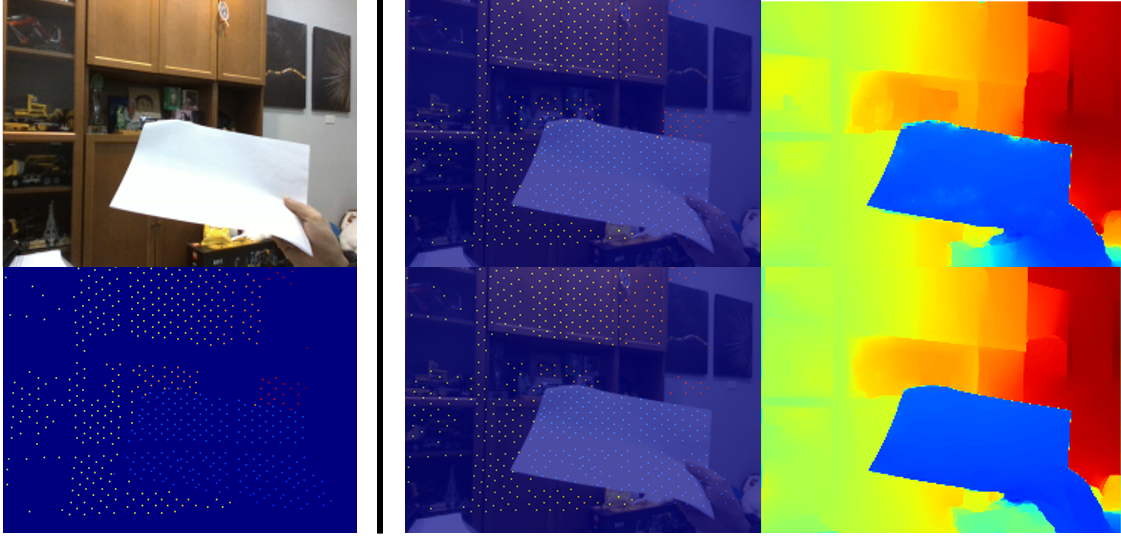
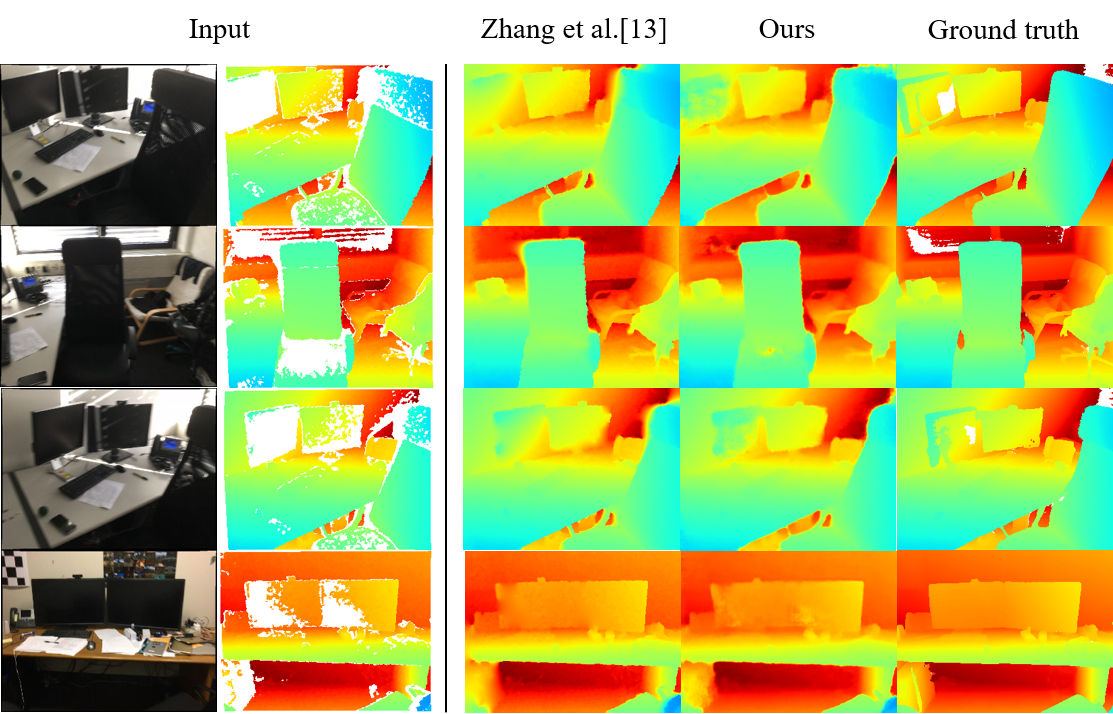
In this article, we propose a method for addressing occlusion errors in depth completion caused by stereo calibration. Our unsupervised training procedure, not relying on any ground-truth data, combines pseudo labels generation and confidence estimation to reduce the amount of error introduced into the depth map for depth completion.
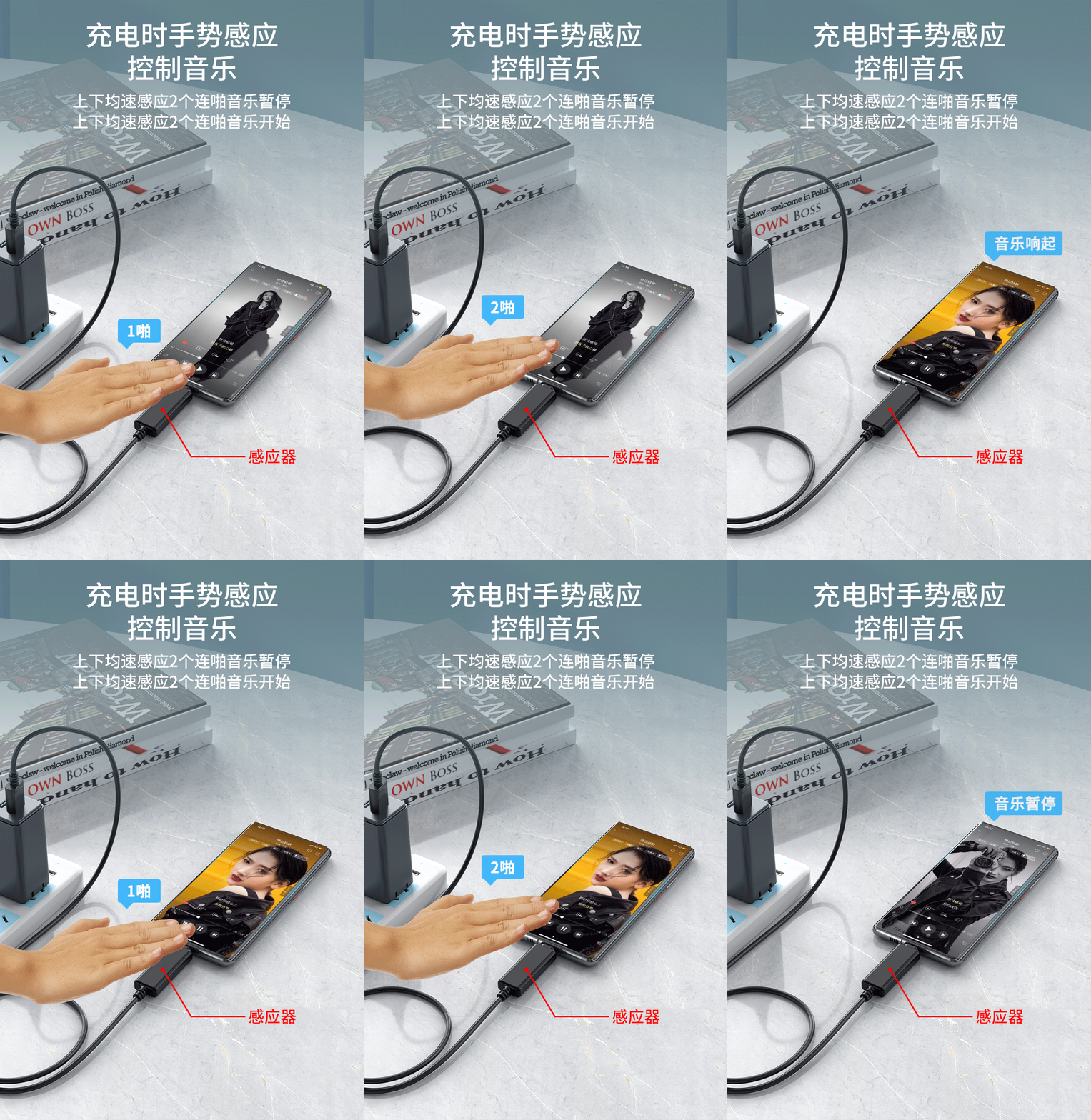
This presentation is a case study where we are demonstrating how we developed gesture-controlled headphones using a radar sensor on Edge AI applications. I was assigned as the SDK project leader to be responsible for this task, and led the machine learning team to design the gesture set for the TWS Headset, build and scale our technology solutions for the mmWave radar system.
National Chung Cheng University · Chiayi · GPA 4.14 / 4.30
Thesis: DEN: Disentangling and Exchanging Network for Depth Completion
Advisor: Ching-Chun Huang
National Kaohsiung University of Applied Sciences · Kaohsiung
Advisor: Chih-Hsiung Yang
You-Feng Wu, Vu-Hoang Tran, Ting-Wei Chang, Wei-Chen Chiu, Ching-Chun Huang, "DEN: Disentangling and Exchanging Network for Depth Completion", International Conference on Pattern Recognition (ICPR), Sep. 2020.
You-Feng Wu, Hoang Tran Vu, Ching-Chun Huang, "Semi-supervised and Multi-task Learning for On-street Parking Space Status Inference", Multimedia Analysis and Pattern Recognition (MAPR), May 2019.
You-Feng Wu. 2023. Taiwan Patent I810564, filed May 14, 2021.
Google PatentsYou-Feng Wu. 2022. Taiwan Patent I786678, filed Jun. 11, 2021.
Google PatentsYou-Feng Wu. 2022. Taiwan Patent I756122, filed Apr. 30, 2021.
Google PatentsYou-Feng Wu. 2021. Taiwan Patent I748778, filed Dec. 2, 2020.
Google PatentsYou-Feng Wu. 2020. U.S. Patent Application 17/084,986, filed Oct. 30, 2020. Patent pending.
ICPR 2020
In this paper, we tackle the depth completion problem. Conventional depth sensors usually produce incomplete depth maps due to the property of surface reflection, especially for the window areas, metal surfaces, and object boundaries. However, we observe that the corresponding RGB images are still dense and preserve all of the useful structural information. The observation brings us to the question of whether we can borrow this structural information from RGB images to inpaint the corresponding incomplete depth maps. In this paper, we answer that question by proposing a Disentangling and Exchanging Network (DEN) for depth completion. The network is designed based on the assumption that after suitable feature disentanglement, RGB images and depth maps share a common domain for representing structural information. So we firstly disentangle both RGB and depth images into domain-invariant content parts, which contain structural information, and domain-specific style parts. Then, by exchanging the complete structural information extracted from the RGB image with incomplete information extracted from the depth map, we can generate the complete version of the depth map. Furthermore, to address the mixed-depth problem, a newly proposed depth representation is applied. By modeling depth estimation as a classification problem coupled with coefficient estimation, blurry edges are enhanced in the depth map. At last, we have implemented ablation experiments to verify the effectiveness of the proposed DEN model. The results also demonstrate the superiority of DEN over some state-of-the-art approaches.
MAPR 2019
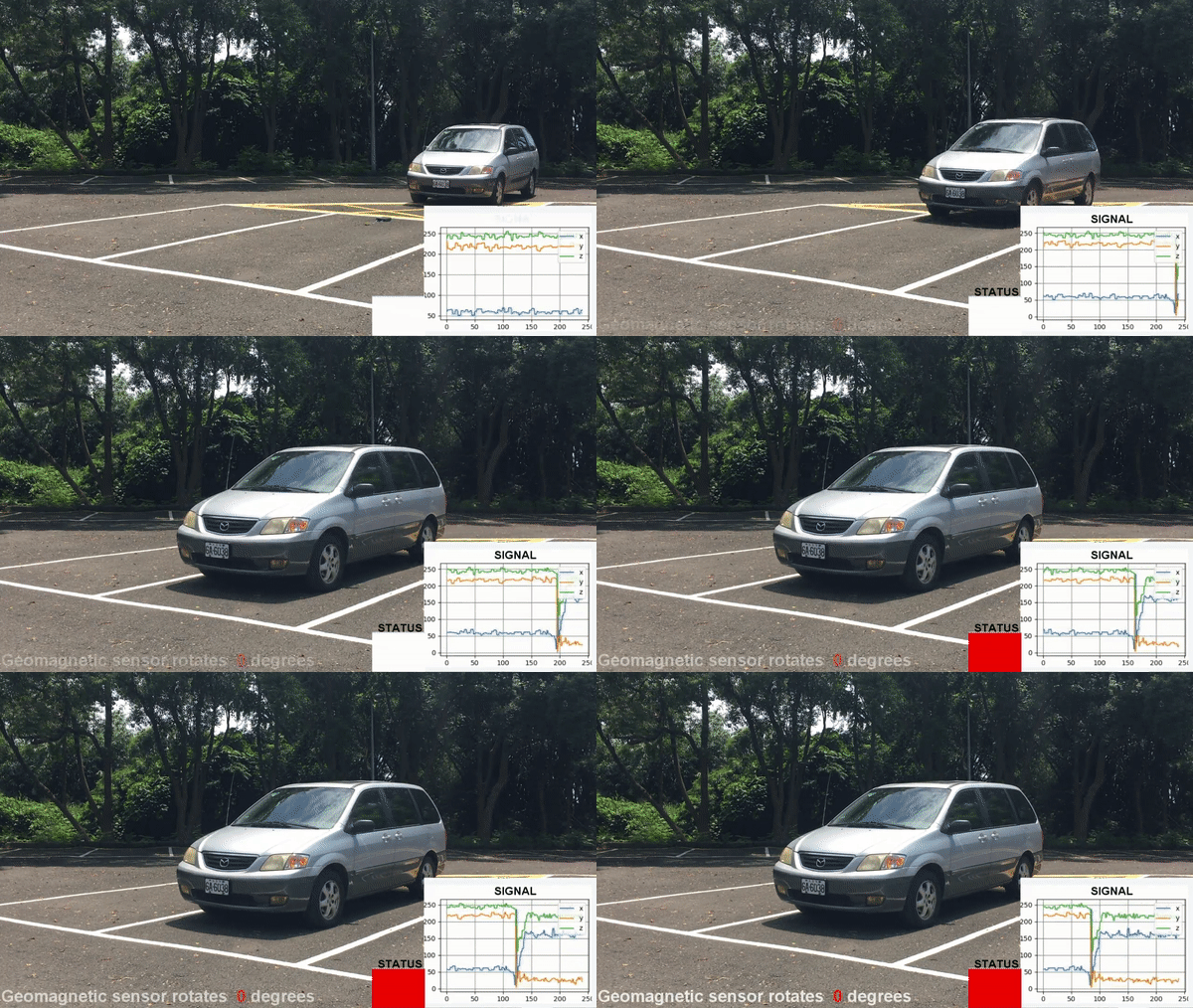
To manage on-street parking spaces, magnetic sensor is often used due to its low cost and flexibility in installation and usage. However, its signals are easily affected by environment, vehicle type, installation location and moving neighboring vehicles. Besides, accidental installation also leads to non-unified coordinate of magnetic sensors which makes the management system difficult to recognize. To overcome these challenges, we proposed a novel semi-supervised and multi-task learning framework for sensor based on-street parking slot inference with three contributions. First, a Coordinate Transform Module is integrated into our framework to reduce the diversity of input signals by transforming them adaptively into a unified coordinate. Second, to learn the generalized and discriminative features while minimizing the amount of labeled data, we introduce a Multi-task Module to leverage the information from both labeled and unlabeled data. Third, we embed a Temporal Module, which observes and memorizes the parking states from time to time, to infer parking space status in a reliable way. The experimental results show that, with the proposed three modules, our end-to-end training framework could reduce the error detection and hence improve the system accuracy.
Feb. 2018 – Jun. 2018
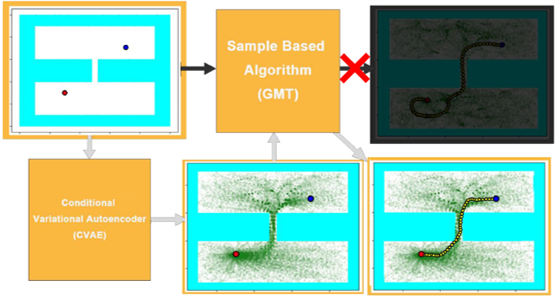
Traditionally, Sampling based motion planning (SBMP) has emerged as a successful algorithmic paradigm for solving high dimensional, complex, and dynamically constrained motion planning problems. However, the performance of SBMP is tied to the placement of samples in these promising regions, a result uniform sampling is only able to achieve through sheer exhaustion. We proposed a methodology for non uniform sampling which can improve the convergence speed of traditional particle based scattering algorithm.
Jul. 2017 – Feb. 2018
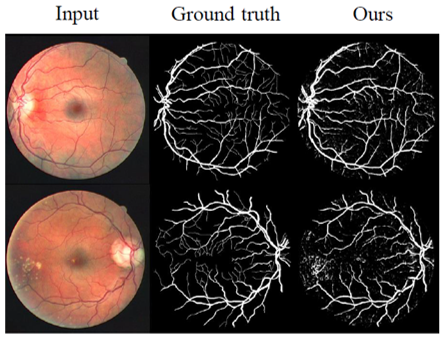
Most of the image segmentation task is completed by U-net. For better performance, we combine U-net and inception module for retina segmentation.
Nov. 2017
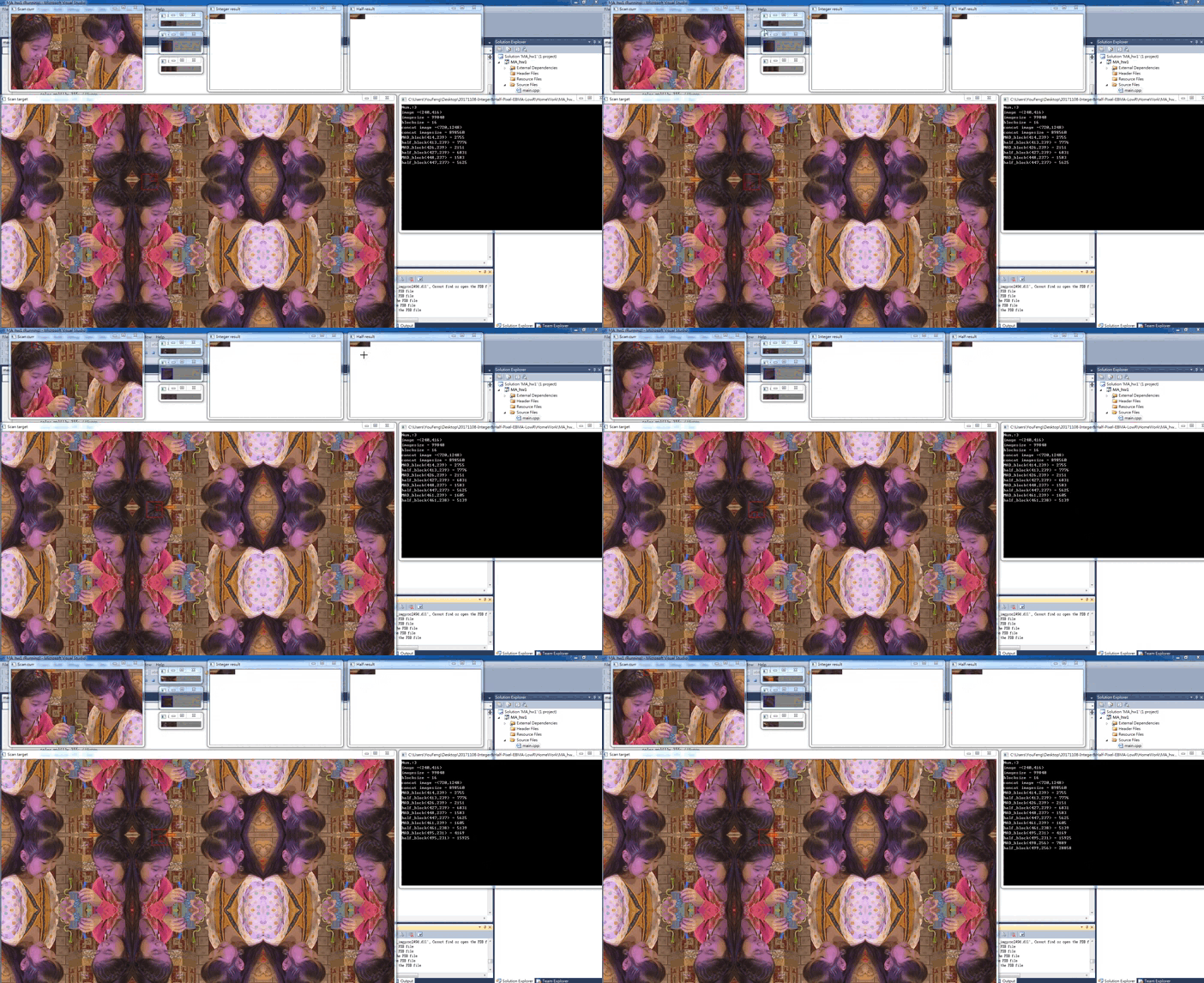
Assume that the adjacent frames are similar and change are due to object or camera motion, we can predict a new frame from a previous frame and only code the prediction error.
Feb. 2017 – Nov. 2017 · MOST-107-2622-E194-007-CC3
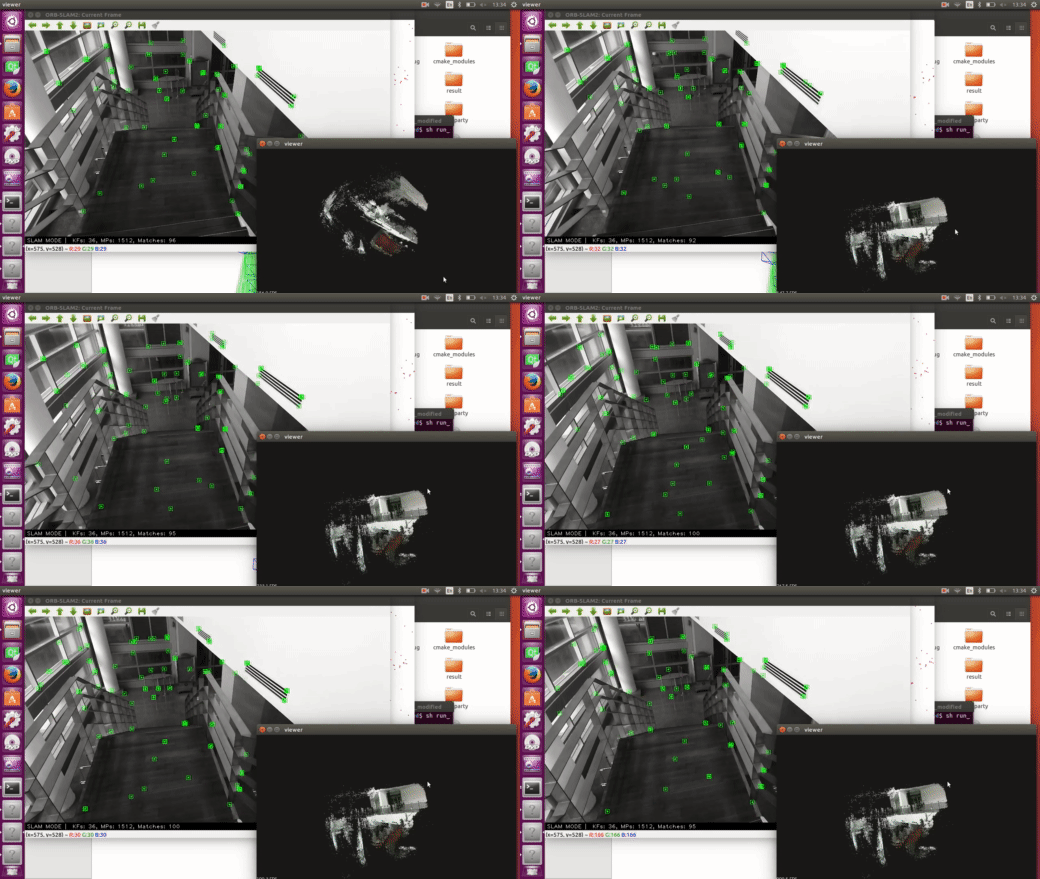
Nowadays, there are many service robots in the market; however, only few of them become a popular product. Among them, the vacuum cleaning robot might be the most successful one and treated as the key entry point toward the future market of service robots. In order to enable the intelligent function in a cleaning robot, the ability for a robot to Simultaneous Localization and Mapping (SLAM) is the fundamental and critical step. Hence, in this project, we aim to study and implement the SLAM algorithm in a cleaning robot.
Artificial intelligence and machine learning are changing the world. In this lecture, we are going to introduce: (1) everything a marketer needs to know about machine learning, and (2) how to efficiently fine-tune a model.
Last updated on 2026-08-25